Summary
This proposal addresses a common limitation in The Sandbox Dashboard’s custom avatar system. Currently, users can customize avatars with hairs, clothes, skin colors, and more — but there is no option for a basic flat avatar without modified geometries. This creates technical issues when testing equipment in VoxEdit and experiences, leading to severe z-fighting between avatar geometries and equipment templates.
The proposed solution introduces a streamlined avatar system that both eliminates z-fighting and expands customization possibilities for players.
Problem Statement
- No basic avatar option: All customizable avatars include modified geometries by default.
- Z-fighting in experiences: Equipment modeled in VoxEdit (based on the Medium Human template) clashes with custom avatar geometries, causing visual glitches.
- Limited customization flexibility: Current system merges geometry changes directly into avatars, restricting modularity and equipment compatibility.
Proposed Solutions
1. Basic Flat Avatar Option
- Introduce a selectable basic flat avatar in the Dashboard.
- Geometry matches the Medium Human template used in VoxEdit.
- Ensures equipment fits seamlessly without z-fighting.
- Provides a clean base for creators and players.
2. Modular Customization System (Detailed Explanation)
The new process would begin with a basic flat avatar (male or female), aligned with the Medium Human template. From this neutral base, users would build their avatar by selecting modular features, each treated as an equipment piece rather than baked‑in geometry.
Step‑by‑Step Flow
- Choose Base Avatar
. Start with a flat avatar (male or female).
. Geometry matches VoxEdit’s Medium Human template, ensuring compatibility with equipment. - Pick Skin Color
. Behind the scenes, each skin tone corresponds to a different base avatar variant.
. No overlapping geometries — just a clean swap of the base mesh. - Select Hair (Head Equipment)
. Hair is treated as an equipment piece.
. Accessories (e.g., glasses, hats, headbands) can be bundled with hair options. - Select Upper Body Clothing (Chest & Arms Equipment)
. Options include shirts, blouses, coats, jackets, etc.
. Each item is modular, layering over the chest/arm geometry. - Select Lower Body Clothing (Leg Equipment)
. Options include trousers, shorts, skirts, etc.
. Shoes are bundled with lower body equipment.
This way, when a player equips an item in an experience, it swaps with their chosen appearance instead of overlapping geometries.
Benefits:
. Eliminates z-fighting permanently (in this case).
. Expands creative freedom for users.
. Aligns Dashboard customization with VoxEdit’s equipment system.
. Future-proof foundation for new avatar features.
Impact:
. Players: More freedom, smoother experiences, no visual glitches.
. Creators: Reliable template for designing equipment, reducing frustration.
. The Sandbox ecosystem: Stronger alignment between Dashboard and VoxEdit, improving overall user satisfaction and adoption.
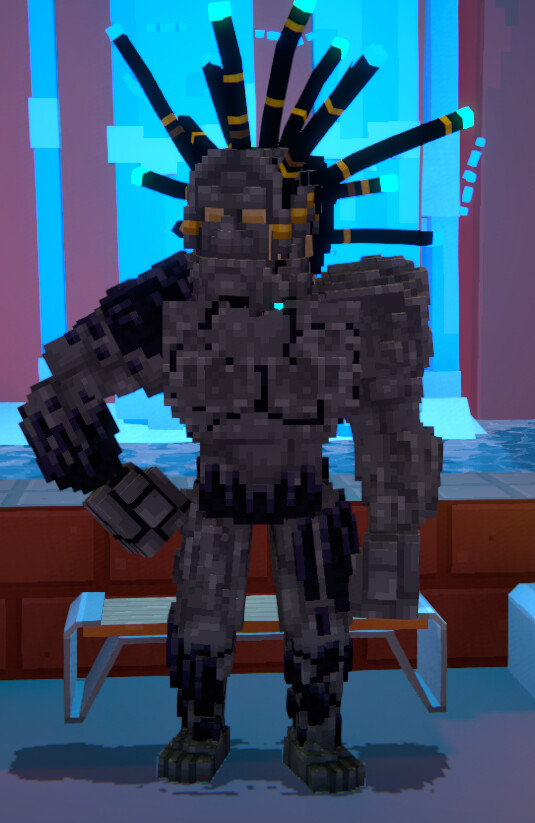
3. Minor Collateral Issue: “Muscles” in Custom Avatars
Currently, some custom avatars include muscles as part of their skin geometry. These are essentially enlarged or “grown” body parts baked into the avatar mesh.
Why This Is a Problem
-
Muscles are not modular — they are fused into the avatar’s geometry.
-
This creates inconsistencies when equipping clothing or armor, since the geometry overlaps or distorts.
-
It reduces flexibility for creators and players who want clean, modular customization.
Proposed Solution
Treat muscles as part of clothing/equipment, rather than as permanent geometry.
-
Example: A “muscle shirt” or “armored chest” could add bulk to the avatar.
-
Muscles would then be modular, swappable, and compatible with VoxEdit equipment.
-
This approach keeps the base avatar flat and clean, while still allowing players to express strength or style through clothing choices.
Benefits
-
Eliminates geometry conflicts with equipment.
-
Keeps avatar customization consistent with the modular system.
-
Expands creative freedom: muscles become a fashion/armor choice, not a fixed trait.
Next Steps
. Community discussion and feedback.
. Technical feasibility assessment by The Sandbox team.
. Prototype implementation with images/mockups (to be provided).
 General
 SIP: Ideas